I have been off the blog for a while, a ton of new info with Lucas that I need to disseminate, however one huge thing I want to inform you about is iron levels. Lucas's iron level is very high, come to find out many children with T21 have high iron levels. (My brain starts thinking of all the things we are trying to avoid like viruses - use iron for energy, leukemias - ditto, also high level of unbound iron can damage mitochondria via oxidative stress - we know this tends to be high in children with T21 and older adults with Alzheimer's). It seems there are answers to commonly seen features of "the syndrome."
There is a condition known as hemochromadosis, it is a genetic disorder which results in faulty iron metabolism and can be seen in children with T21 because the gene is carried on the 21st level. Lucas is having a simple blood test to see if he has the gene. If he does there are methods of correction, if he does not, we need to take another look at his supplements to make sure we are protecting his mitochondria.
Regardless of how old your child is, ask your pediatrician the last time an iron level was taken. There is total iron which is high, but then there is the saturation level. (In Lucas the saturation level was well within range. This means that although there is excess iron in his system it is bound up at this point and is not roaming free to damage his cells' mitochondria. Good time to find the problem!) Ask your child's doctor to check both. I have so much to tell, but this is critically important to health.
As long as you have your little one at the lab for a jab ask your doctor to get a gluten sensitivity test done. We know celiac problems are common to children with T21 and therefore celiac disease is checked for routinely, but Gluten sensitivity is not. Lucas tests for sensitivity came back very high, clearing the gluten out of his diet was a good move.
Talk soon!
Tuesday, December 7, 2010

Thursday, October 7, 2010
A Free e-book From Diagnosis to Delivery
This is a great resource for expectant mothers and fathers who have learned they are expecting a baby with T-21. Long overdue, and much more to be done, but please feel free to share.
http://downsyndromepregnancy.org/
http://downsyndromepregnancy.org/
Sunday, October 3, 2010
"Down Syndrome Awareness Month"

My idea of awareness is enlightening those who do not know - and may not have ever had the opportunity to know - what it means and does not mean to have trisomy 21. Educating new parents about hard earned knowledge to make their journey a bit smoother and describing a true reality that they can not find in books. Telling new parents that the devastation is real but not lasting, their days will be long but their years short, preparing them for the overwhelming instinct to find answers to questions that will help their child achieve and be well, and the absolute disdain for any opinion that seeks to limit their child.
I knew what it meant to be a mother and I wondered in the earliest of moments after Lucas was born how things would change - how I would have to change. Three years later I want to let new parents know that nothing changed. I still lay my head down at night and systematically check off every concern, achievement and "to do" for all of my boys. I create schedules and lists to accommodate everything that needs to be done. I cry when I see one of my boys hurting and I discipline to make sure they grow up to be good men. I refuse to let any of them back out on a commitment, break a promise or sell themselves short. I provide opportunity for them to learn things they wont need to know for some time and love to watch them succeed. There is no difference between Noah and Ryan and Lucas. They all get all that I have to give.
I know the prospect of raising a child with "special needs" is frightening, but truthfully, we can not know the future for any of our children. We will be faced with challenges and difficulties, successes and failures. I find that at the times I am needed most, I have the most to give.
Instead of attending a walk or a party, our family will be raising awareness by example...on the playground, at preschool, at church, in grocery stores, with friends and family. I will speak and write. Most importantly, I will continue looking and searching for ways to help my son be well and achieve and share that knowledge with anyone who will listen.

Tuesday, September 28, 2010
Regarding Treadmill Article
I just wanted to comment on something that was discussed in the article. The author points out that walking is imperative to environmental exploration and the subsequent perceptual / cognitive development and although I agree walking provides a new level of independence, I disagree that our babies perceptual, cognitive, and self direction skills should be made to wait for their legs to get with the program! If we wait to provide environmental exploration opportunities until baby is even 12 months old, it will be too late to ensure this desire is part of baby's nature. (What if you were allowed to hang out in a swing, or carrier and everything was brought to you? Would you then appreciate being told to get up and go take care of things for yourself?)
Hopefully my book will be available soon, I go in depth of how to set up environments that allow independent exploration regardless of physical skill level. Here is a brief list of ideas...
1. get rid of a play pen / pack and play - get baby on floor during awake time. Find a room or area that is just his - get rid of furniture and obstacles and place all the things baby loves most around the perimeter. Whether he rolls, creeps or crawls, the message is clear - you want it? go get it! Plus, once baby has some mobility and self direction to explore, placing him in a confined space like a playpen or crib undermines it.
2. Do not use swings, carriers, etc to keep baby occupied - it reinforces the idea that they are to sit and wait for things to happen
3. TURN OFF THE TV - a baby can remain stationary in one place for hours and the TV continues working (among other negative effects.) Turn it off.
4. Family game night? get everyone on the floor - reading time for older children? Build "forts" with blankets and get on the floor- older kids will LOVE reading time - the forts will become a "hang out" and baby is included on many levels - obvious benefits of being read to, self direction to see what's going on, familial inclusion, fun, gross motor and fine motor, perceptual, cognitive, etc., etc. Use babies innate desire to be part of the action to your benefit. If everyone is in the fort reading out loud, baby will be wriggling like crazy to get in there!
These are just the tip of the iceberg. You can think of hundreds of ways to allow (not provide) baby to explore. By the time baby starts walking, he will just use that skill to take his explorations to a new level...and then Good Luck with that!
Hopefully my book will be available soon, I go in depth of how to set up environments that allow independent exploration regardless of physical skill level. Here is a brief list of ideas...
1. get rid of a play pen / pack and play - get baby on floor during awake time. Find a room or area that is just his - get rid of furniture and obstacles and place all the things baby loves most around the perimeter. Whether he rolls, creeps or crawls, the message is clear - you want it? go get it! Plus, once baby has some mobility and self direction to explore, placing him in a confined space like a playpen or crib undermines it.
2. Do not use swings, carriers, etc to keep baby occupied - it reinforces the idea that they are to sit and wait for things to happen
3. TURN OFF THE TV - a baby can remain stationary in one place for hours and the TV continues working (among other negative effects.) Turn it off.
4. Family game night? get everyone on the floor - reading time for older children? Build "forts" with blankets and get on the floor- older kids will LOVE reading time - the forts will become a "hang out" and baby is included on many levels - obvious benefits of being read to, self direction to see what's going on, familial inclusion, fun, gross motor and fine motor, perceptual, cognitive, etc., etc. Use babies innate desire to be part of the action to your benefit. If everyone is in the fort reading out loud, baby will be wriggling like crazy to get in there!
These are just the tip of the iceberg. You can think of hundreds of ways to allow (not provide) baby to explore. By the time baby starts walking, he will just use that skill to take his explorations to a new level...and then Good Luck with that!
Monday, September 27, 2010
Treadmill Training
This is probably the only intervention I had learned about that I did not use with Lucas. I desperately wanted to, but finding a treadmill that would work was difficult. Even now a couple years later it seems that they are much easier to come by. The theory behind it is solid. All babies have a stepping reflex, which basically means if you place the child on their feet and lean them forward, one foot will automatically come out.
To hold a child on a treadmill with this reflex you are get continual eliciting of the reflex. Biomechanically, it doesn't mean much, but neurologically the benefits are numerous.
1. Increased communication between the 2 hemispheres of the brain
2. Feeding normalized sensation of what "recipricol movement" feels like into baby's brain.
3. Organization of the gross motor pathways which have connections to virtually every other area of development - the benefit of "cross patterns" are well recognized.
4. Increased proprioceptive input to lower extremities. (pressure sense, sometimes because of low tone a child will demonstrate postural instability, which means they are literally afraid to take a step because of being "unsure." This interferes with everything from walking to stair use and other higher level physical skills.)
5. I'm sure any mom or dad would find a way to turn this into a fantastic game filled with silly songs and rhyming stories set to the beat of the footsteps.....multisensory, multisensory, multisensory!
I'm sure the OT in me could continue with this list ad nauseum, but it is something I think you should know about. This isn't event a disputed benefit, the evidence is clear, treadmill training with babies with trisomy 21 helps them walk much earlier than those who didn't have the benefit. I think from a neurodevelopmental standpoint the benefit is FAR greater!
www.ns.umich.edu/htdocs/releases/story.php?id=6142
To hold a child on a treadmill with this reflex you are get continual eliciting of the reflex. Biomechanically, it doesn't mean much, but neurologically the benefits are numerous.
1. Increased communication between the 2 hemispheres of the brain
2. Feeding normalized sensation of what "recipricol movement" feels like into baby's brain.
3. Organization of the gross motor pathways which have connections to virtually every other area of development - the benefit of "cross patterns" are well recognized.
4. Increased proprioceptive input to lower extremities. (pressure sense, sometimes because of low tone a child will demonstrate postural instability, which means they are literally afraid to take a step because of being "unsure." This interferes with everything from walking to stair use and other higher level physical skills.)
5. I'm sure any mom or dad would find a way to turn this into a fantastic game filled with silly songs and rhyming stories set to the beat of the footsteps.....multisensory, multisensory, multisensory!
I'm sure the OT in me could continue with this list ad nauseum, but it is something I think you should know about. This isn't event a disputed benefit, the evidence is clear, treadmill training with babies with trisomy 21 helps them walk much earlier than those who didn't have the benefit. I think from a neurodevelopmental standpoint the benefit is FAR greater!
www.ns.umich.edu/htdocs/releases/story.php?id=6142
Sunday, September 26, 2010
Just Came Across This Photo
I was just going through photos for a presentation I am giving and I found these.
Smart little bugger from the beginning! (Not to mention those fine motor skills!)
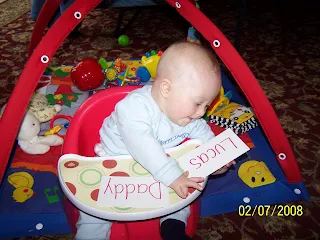 From the date, I can see Lucas was just over 5 months old. We started our reading program with the names of people in Lucas's life. I can not tell you how encouraged I was to see him understand and learn so quickly. Lucas has taught me many things, but the most important was never to underestimate him! (And yes I had him in a pod chair for reading time because he had to engage his back and core muscles, receive the proprioceptive input through the spine and figure out distal mobility on proximal stability, control his head and eye movements, all while concentrating on something else. No reason to just work on reading, better to use a multisensory approach and let Lucas experience several things at once! Didn't take him long to catch on, and we were sitting for reading without our handy pod chair!)
 We included our reading words into the rest of our day and from the lovely dish towel on the ground I am assuming this was after dinner when I was cleaning the kitchen. The only thing missing is Noah and Ryan who would usually be putting new words up and playing peek-a-boo from behind the walls. Lucas would stretch up to see them, pushing on his little hands and arms, and if he happened to be watching them move back and forth, he would weight shift and roll over the boppy roll! I realized that not only did I not have to lower my expectations for Lucas, but I'd have to be pretty creative to keep him stimulated. He craved learning and trying new things. He still does today!
Smart little bugger from the beginning! (Not to mention those fine motor skills!)


Sunday, September 19, 2010
Connecting The Dots
I've not posted in a while, I have been in a whirlwind of new information and consultations. I have exponentially increased my understanding of the interconnectedness of many seemingly unconnected interventions. I mentioned in a previous post that I saw overlaps between symptoms of "the syndrome" and potential causes. I am more certain than ever that it is possible to have Trisomy 21 but little evidence of Down Syndrome.
I want to give you some new information I've obtained, but just as important as the information itself in the way I've obtained it - several unconnected sources, utilizing similar methods, achieving the same results.
I've mentioned in my blog about Kristen Morrison in Australia who has written Naturally Better, a phenomenally comprehensive book of natural supplements and techniques to intervene in our children's development before the symptoms of the syndrome become evident. She followed the programs from the Institutes of the achievement of human potential, intervened with natural supplements to maximize health and wellness (immunology being a part of that), and obtained treatments from an Osteopath (analogous to the chiropractor in the US.) I would encourage you to google her and look at the volume of photos of her son Gryffin. Besides his excellent health, cognition and physical development, he is visually very uninvolved, almost to the point that the T21 is undetectable.
I took Lucas to the chiropractor in the article I posted. He has a daughter with T21 who has had the benefit of his services since birth. She is a healthy and beautiful girl. Oh, and by the way, his wife is a naturalist, believing in natural interventions to maximize health and wellness.
We have provided supplements and vitamin therapy to Lucas from 5 months of age, used techniques based on neurodevelopmental principles, cleared his diet of sugars, preservatives, dyes and non organic food sources, and to a great degree gluten, increased his intake of essential things like glyconutrients, amino acids and enzymes, and guess what? Lucas is doing very well with minimal visual involvement as well.
That's three for three. I point this out only because I believe there is a whole movement going on, but no one is talking about it. If you wonder why, try convincing one of your child's doctors or specialists that you expect wellness, intelligence and uninvolved features (among many other things) from your child. Aside from the specialists, try convincing other parents who have only employed traditional methods and embraced the "special needs" approaches filled with compensatory techniques and albeit unknowingly, lowered expectations for their children.
I have just finished reading a written opinion that alternative approaches to neurologic problems are "irresponsible" and that no recognized medical research has ever proven any of it does anything. Admittedly knowing little of the person who wrote such a thing, I have to wonder if this person has ever thought about what she was saying. Natural supplements, gentle adjusting of the spine, vitamin therapy, Tomatis therapy, etc., are "irresponsible" and yet the formally recognized medical opinion for our children's health is to expect illness and limitation secondary to the extra chromosome, use of antibiotics, synthetic thyroid stimulating hormones and other drugs to manage the symptoms of the syndrome is responsible? Desirable? Effective? We as parents with aspirations of achievement for our children should not seek any and all methods that do no harm in effort to maximize health and development? I wonder if this lady has ever had a massage to reduce stress or taken a zinc lozenge to ease a cold. Rediculous is the criticism that stands in the way of true progress, forward thinking and success.
In working with our developmental pediatrician / naturopath (she is a rare breed indeed!) I have been learning much about the interconnectedness of things like omega 3 and speech, vitamin D and immunity, red blood cell size and the body's ability to use certain vitamins and nutrients. I have learned the most important thing I can do right now is to get a series of blood work done on Lucas so we can put the puzzle together. Naturally supplement what's out of balance so health is maximized. Why does that idea seem so radical?
As an OT I have always had respect for the fact our nervous systems control every part of our bodies and the pure structure of our anatomy can lead to nerve entrapment, tissue damage resulting in muscle imbalances, and even metabolic disturbances. Look no further than a patient with a spinal cord injury who profusely sweats, loses their hair, or has a dip in blood pressure from a change of gravitational force. The nervous system does not operate on a 1:1 cause effect basis, it is a complex series of events that control every part of us from thinking, to moving, to immunity. In researching the theory behind chiropractic care for children with neurologic disorders, I realize it is just that - a theory. But it is a darn good one. If I can maximize the efficiency of the metabolic system through a series of gentle adjustments to the spine to ensure everything is in balance, I would be hard pressed to see the downside.
In taking a natural approach, I find the overlaps are incredible. The immune system is being positively acted on by diet, supplementation, vitamin therapy and chiropractic care. Each blood test reveals one more clue, one more secret to how the extra chromosome has manifested itself in Lucas's metabolism and giving us the opportunity to supply what is deficient naturally. In turn, Lucas's cognition is enhanced by his overall wellness, antioxidant therapy, vitamin therapy, early literacy, therapeutic play, and most of all high expectations. His overall health and cognition allow him to further participate in school, social activities, and sports which in turn feed back into the loop of wellness. I could go on down the list of every part of the "syndrome" or "phenotype" and list at least 3 or 4 natural interventions which in turn impact 3 or 4 additional areas.
There needs to be a plan, one that we are willing to talk about, one that we are willing to be criticized for by those we deeply respect. There are many new and expectant parents out there with a feeling in their gut that there is a better way. There are many who are finding their way despite the nay saying and criticism. I think of the list of things we have obtained for Lucas. All of them natural, none of them harmful. I think back to the woman who wants proof. Proof is impossible. If I apply all I know and have success it will be discounted as simply the way Lucas's genes expressed themselves. The only way I can prove my methods are having an impact is to stop them. I will never stop. I will continue to find non obtrusive ways to help my child achieve all he can. There needs to be a paradigm shift from managing symptoms of the syndrome to preventing the development of symptoms in the first place. If we understand the "why" then we can find a way.
I keep thinking about the cognitive tests Lucas underwent this past summer. Some comments were "areas of major strength are memory and the ability to generalize information." Anyone familiar with the learning problems of children with T21 know that memory and generalization are two huge obstacles to learning. I also think about the doctor we flew to see in Baltimore who conducted research on the vitamin / antioxidant / enzyme therapy we embarked on telling me to start immediately. New thinking is that the earlier in life a child starts the therapy, the more cognitive function is enhanced. Proof? I don't need proof, I don't need statistical significance, I need to unravel the mystery and find new ways to help Lucas learn and be well..new ways that are effective and do no harm.
I want to give you some new information I've obtained, but just as important as the information itself in the way I've obtained it - several unconnected sources, utilizing similar methods, achieving the same results.
I've mentioned in my blog about Kristen Morrison in Australia who has written Naturally Better, a phenomenally comprehensive book of natural supplements and techniques to intervene in our children's development before the symptoms of the syndrome become evident. She followed the programs from the Institutes of the achievement of human potential, intervened with natural supplements to maximize health and wellness (immunology being a part of that), and obtained treatments from an Osteopath (analogous to the chiropractor in the US.) I would encourage you to google her and look at the volume of photos of her son Gryffin. Besides his excellent health, cognition and physical development, he is visually very uninvolved, almost to the point that the T21 is undetectable.
I took Lucas to the chiropractor in the article I posted. He has a daughter with T21 who has had the benefit of his services since birth. She is a healthy and beautiful girl. Oh, and by the way, his wife is a naturalist, believing in natural interventions to maximize health and wellness.
We have provided supplements and vitamin therapy to Lucas from 5 months of age, used techniques based on neurodevelopmental principles, cleared his diet of sugars, preservatives, dyes and non organic food sources, and to a great degree gluten, increased his intake of essential things like glyconutrients, amino acids and enzymes, and guess what? Lucas is doing very well with minimal visual involvement as well.
That's three for three. I point this out only because I believe there is a whole movement going on, but no one is talking about it. If you wonder why, try convincing one of your child's doctors or specialists that you expect wellness, intelligence and uninvolved features (among many other things) from your child. Aside from the specialists, try convincing other parents who have only employed traditional methods and embraced the "special needs" approaches filled with compensatory techniques and albeit unknowingly, lowered expectations for their children.
I have just finished reading a written opinion that alternative approaches to neurologic problems are "irresponsible" and that no recognized medical research has ever proven any of it does anything. Admittedly knowing little of the person who wrote such a thing, I have to wonder if this person has ever thought about what she was saying. Natural supplements, gentle adjusting of the spine, vitamin therapy, Tomatis therapy, etc., are "irresponsible" and yet the formally recognized medical opinion for our children's health is to expect illness and limitation secondary to the extra chromosome, use of antibiotics, synthetic thyroid stimulating hormones and other drugs to manage the symptoms of the syndrome is responsible? Desirable? Effective? We as parents with aspirations of achievement for our children should not seek any and all methods that do no harm in effort to maximize health and development? I wonder if this lady has ever had a massage to reduce stress or taken a zinc lozenge to ease a cold. Rediculous is the criticism that stands in the way of true progress, forward thinking and success.
In working with our developmental pediatrician / naturopath (she is a rare breed indeed!) I have been learning much about the interconnectedness of things like omega 3 and speech, vitamin D and immunity, red blood cell size and the body's ability to use certain vitamins and nutrients. I have learned the most important thing I can do right now is to get a series of blood work done on Lucas so we can put the puzzle together. Naturally supplement what's out of balance so health is maximized. Why does that idea seem so radical?
As an OT I have always had respect for the fact our nervous systems control every part of our bodies and the pure structure of our anatomy can lead to nerve entrapment, tissue damage resulting in muscle imbalances, and even metabolic disturbances. Look no further than a patient with a spinal cord injury who profusely sweats, loses their hair, or has a dip in blood pressure from a change of gravitational force. The nervous system does not operate on a 1:1 cause effect basis, it is a complex series of events that control every part of us from thinking, to moving, to immunity. In researching the theory behind chiropractic care for children with neurologic disorders, I realize it is just that - a theory. But it is a darn good one. If I can maximize the efficiency of the metabolic system through a series of gentle adjustments to the spine to ensure everything is in balance, I would be hard pressed to see the downside.
In taking a natural approach, I find the overlaps are incredible. The immune system is being positively acted on by diet, supplementation, vitamin therapy and chiropractic care. Each blood test reveals one more clue, one more secret to how the extra chromosome has manifested itself in Lucas's metabolism and giving us the opportunity to supply what is deficient naturally. In turn, Lucas's cognition is enhanced by his overall wellness, antioxidant therapy, vitamin therapy, early literacy, therapeutic play, and most of all high expectations. His overall health and cognition allow him to further participate in school, social activities, and sports which in turn feed back into the loop of wellness. I could go on down the list of every part of the "syndrome" or "phenotype" and list at least 3 or 4 natural interventions which in turn impact 3 or 4 additional areas.
There needs to be a plan, one that we are willing to talk about, one that we are willing to be criticized for by those we deeply respect. There are many new and expectant parents out there with a feeling in their gut that there is a better way. There are many who are finding their way despite the nay saying and criticism. I think of the list of things we have obtained for Lucas. All of them natural, none of them harmful. I think back to the woman who wants proof. Proof is impossible. If I apply all I know and have success it will be discounted as simply the way Lucas's genes expressed themselves. The only way I can prove my methods are having an impact is to stop them. I will never stop. I will continue to find non obtrusive ways to help my child achieve all he can. There needs to be a paradigm shift from managing symptoms of the syndrome to preventing the development of symptoms in the first place. If we understand the "why" then we can find a way.
I keep thinking about the cognitive tests Lucas underwent this past summer. Some comments were "areas of major strength are memory and the ability to generalize information." Anyone familiar with the learning problems of children with T21 know that memory and generalization are two huge obstacles to learning. I also think about the doctor we flew to see in Baltimore who conducted research on the vitamin / antioxidant / enzyme therapy we embarked on telling me to start immediately. New thinking is that the earlier in life a child starts the therapy, the more cognitive function is enhanced. Proof? I don't need proof, I don't need statistical significance, I need to unravel the mystery and find new ways to help Lucas learn and be well..new ways that are effective and do no harm.
Subscribe to:
Posts (Atom)